Showing posts with label Simon Etta. Show all posts

Thursday, August 6, 2009

The Falling Standards in Manyu Schools:

Secondary high school in Manyu Division
In educational cycles, it is generally accepted that competence and commitment of teachers should be the most important determinant of learning outcomes. However, it is difficult to find any systematic studies that have been undertaken on motivational and incentive issues among teachers in Cameroon. Furthermore, it has not been possible to find a study that tracks levels and determinants of teacher motivation and deployment to schools in different parts of the country such as Manyu. Nonetheless, there is strong generalization to conclude, the standards of education in Manyu division are on a downward spiral. Solid evidence based on current GCE results and that of a few years back point a bleak picture. The truth of the matter is educational standards in Manyu schools are actually declining and the long term impact on the social and economic development of the division will be felt for many years, a situation which calls for prompt and impacting intervention.

For most University and Secondary school graduates in African countries, teaching has become employment of the last resort. Consequently, some teachers often lack a strong long term commitment to the vocation. Quite often the status and pay of a primary school teacher is much lower. Thus becoming a secondary school teacher with higher pay stands out as an avenue for social and economic advancement. This trend has important implications for the development of a critical mass of competent and experience teachers in primary schools and this is where early learning begins.

Secondary School Students.
In areas like Manyu, the problem is exacerbated because teachers at both the secondary and primary level refuse to teach in certain communities due to many prevailing infrastructure problems, notably bad roads, acute electricity, water shortages and finally pay incentives. In general, the motivation for teachers at the public education system to perform well is frequently weak due to ineffective incentives and standards. Low pay forces large proportion of teachers to earn secondary income from other sources such as private tutoring. Where teachers bribe to secure employment and desired postings, this may also impact on job commitment and motivation. In these situations, teachers do not feel accountable to school Principals, parents or the wider community. Being posted to a rural school is therefore likely to de-motivate the teacher, and with a low proportion of qualified teachers in rural areas, this amounts to lower standards and failing grades. Another problem is teacher absenteeism due to poor motivation and lack of accountability. As compared to private schools, absenteeism is lower because sanctions are imposed for those absent with no legitimate reasons.


The educational sub-committee of the first Manyu world conference in 1996 had as a term of reference to seek ways and means of promoting academic excellence. In its final report, the sub-committee suggested the following ways to redress the situation:

a) Equip schools with libraries, workshops and functional laboratories. The public should be involved in motivating our children in science based professional, vocational and technical careers. Improve the academic staff in our institutions by providing funds for teachers in disciplines that are related to desired careers.
b) Creation of academic foundations, even those at local levels could be encouraged to promote academic excellence e.g. Dr. Mengot Foundation.
c) Manyu sons and daughters teaching outside must be prepared to come back home whenever they are, to enhance performance in certain fields.
d) Finally, the committee recommended the processing of documents for the acquisition of a plot and the approval of the opening the Manyu polytechnic.

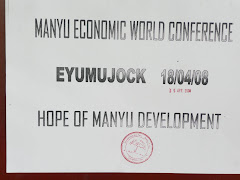
Almost twelve years later, the Manyu economic development world conference met in Eyumojock in 2008. This time around the education committee had a term of reference “poor performance in Manyu schools and how this can be avoided”. The committee identified three problems; lack of teachers, hostile environment and lack of motivation and low pay for PTA teachers. Here are some of the proposed solutions:

a) Training programs to motivate teachers should be organized as well as sourcing for necessary funds.
b) Meritorious Manyu teachers should be awarded certificates of excellence so as to motivate them.
c) Teachers should inculcate a culture of commitment and patriotism.
d) Everybody in society should partake in the training of children.

Based on these committee reports, we recognized the issue of falling standards in our schools almost a decade ago. It is true that lowly qualified and ill motivated teachers will never provide the quality of education needed. There is also evidence of lack of proper infrastructure and congenial environment for effective learning especially with schools in our rural areas. School fees are a barrier especially to our kids from poor backgrounds. Unlike fifteen years ago when the only secondary high school was in Mamfe town with good infrastructure and teachers, most of our students attend government sponsored schools in villages.

MEDWC donates technology equipment to area schools. In order to tackle the falling standards of education in Manyu since most schools are now in our rural communities, we must initiate innovation that could help schools excel in exams to enable the division take its prime position in the educational records of the country. Parents and stakeholders need to exercise control over headmasters, principals and teachers by attending PTA meetings and contributing to infrastructure development. Manyu politicians and those in positions of influence must address entrenched teacher deployment policies in Manyu. Effective decentralization over staffing is the, most effective way of ensuring a more transparent, equitable and efficient deployment of teachers to Manyu urban and area schools. The system should not only force Manyu indigenes to teach in their land of birth but also encourage and motivate them with incentives.

Friday, July 31, 2009

Is Sun Power the Solution to Manyu Energy Crisis?

Solar Street Light NEPAD, Africa’s development blueprint calls for countries in sub-sahara Africa to boost access to cheaper and reliable energy in order to achieve the desired social and economic prosperity for their nations. It is estimated that in some African countries, fewer than 5% have access to electricity with the figure falling to less than 2% in rural areas where the majority live.
Indeed, Africa posses some of the world’s largest watercourses –hydro potentials as well as worlds’ largest oil, coal and gas reserves. In order to move forward, African nations must find cheaper power sources to ensure sustainability and minimize environmental hazards. Experts believe that solar power, clean and renewable is the way forward for energy consumption in Africa.


Solar Technology

The sun is free, priceless and inexhaustible. Solar technology therefore converts the sun’s radiation directly into electricity with no pollution or harm to the environment. Solar panels generate enough power to run appliances such as televisions, radios, stoves, water pumps and produce light for households. Basically, the solar panel itself is a battery charger. When exposed to sunlight it produces direct current (DC).
The solar charge controller regulates the amount of energy that the panels put into the battery. Once the battery is fully charged it opens the circuit to prevent damaged caused by overcharging. After using some of the stored energy, it automatically closes the circuit and starts to recharge the battery during sunlight hours. Solar panels are rated in watts. For example, a 12 volt 15 watt panel averages about 15 watts per hour of sunlight. Multiple panels can be wired together in most cases. Another component used with solar panel is the inverter. It converts 12 volt DC energy in the battery to standard 220 AC voltages found in homes in Africa. Finally, batteries used in Solar systems must be deep cycle types. A standard car battery will be damaged quickly. The two common types of batteries used in Solar are sealed lead acid deep cycle and standard marine.

Case study – Ethiopian and Zimbabwe villages

According to BBC news, two years after the installation of a solar power project funded by international aid groups, villagers in northern Ethiopia now say the sun’s energy has turned their lives around. Rema, 150 miles north of Addis Ababa is home to Ethiopia’s largest solar project with every house in the village powered by solar lighting systems amounting to over 2100 homes. Village roofs are dotted with solar panels and one panel provides power for four lamps as well as energy for radios and tape players. Villagers now don’t have to struggle with smoke from wood or other biomass such as crop waste dominant fuel for cooking. Gas lamps are now something of the past, kids can do their homework and local businesses have seen an increase in night time activities. As in Ethiopia, some numerous villages in Zimbabwe turned to solar power in the 1990’s, a project supported by UNDP through the global environment facility (GEF). This project installed 9000 solar power systems throughout the country in a bid to improve living standards and curtail land degradations.


Bringing Sun Power to Rural Manyu:

Solar projects like those implemented in Ethiopia and Zimbabwe villages did not happen by some divine intervention. These projects were developed, initiated and forwarded to international organizations by stakeholders of those areas. By this we mean the indigenes and there lies the challenge and task in front of groups like MECA USA , MEDWC and development minded Manyuans.

Despite substantial amounts of money invested in the energy sector, only a minority of Manyu rural households are able to enjoy modern services provided by electricity. The majorities of people in our villages have no grid based electricity, and will not receive nor use it in their lifetime. In most of our villages, solar will make sense because households do not consume much electricity, at least initially. Village household usage is limited to a few lamps (2-3), a radio and or TV equivalent to 30-50 KWh per month. These services can easily be provided by low cost solar systems. Better access to electricity would definitely make a big difference to the quality of life in rural Manyu.

Solar panels mounted on the roof of a Village house.Although our people sometimes consume conventional modern energy, they do so in small amounts and pay dearly. Imagine dry cell batteries, they provide electricity but expensive. A candle or kerosene wick lamp does give light but a house will need much more to obtain same amount of light emitted by a single 40 watt incandescent lamp or 12 w compact fluorescent. Those who use candles and kerosene limit themselves to using enough light points to walk around the house. Hence the rural Manyu man has limited access to energy because of cost and accessibility. The levels of service our rural households enjoy now are only barely distinguished from that of medieval Europe. The Manyu rural household will never obtain a level of service, and improvement in social and economic conditions comparable to urban dwellers unless they get access to electricity - other than wood, dry cell batteries and biomass.

Future action:

For decades, kerosene lamps and sore eyes are the routine for children in Manyu villages to study and do their home work. Imagine painful eyes and headaches from fumes, not to mention the long term health impact of mothers cooking with firewood and inhaling smoke. How about impact on life span, aging and not living long enough to see their children grow? The Manyu land is blessed with plenty sunlight all year round. We can tap into this free and clean energy source to light up our remote and isolated villages that will never be linked to the national electricity grid. It can be done one house and one village at a time.

We owe it to our people, for economic prosperity and better living to explore the solar option. Bringing solar energy to a Manyu village is now conceivable than ever before. The average price of a one watt panel including electronics runs $7-$10 or 3500cfa - 5000CFA. With $500, we can light up a village hall.